
Care to Career: Your Guide to B.Sc Nursing in Bangalore
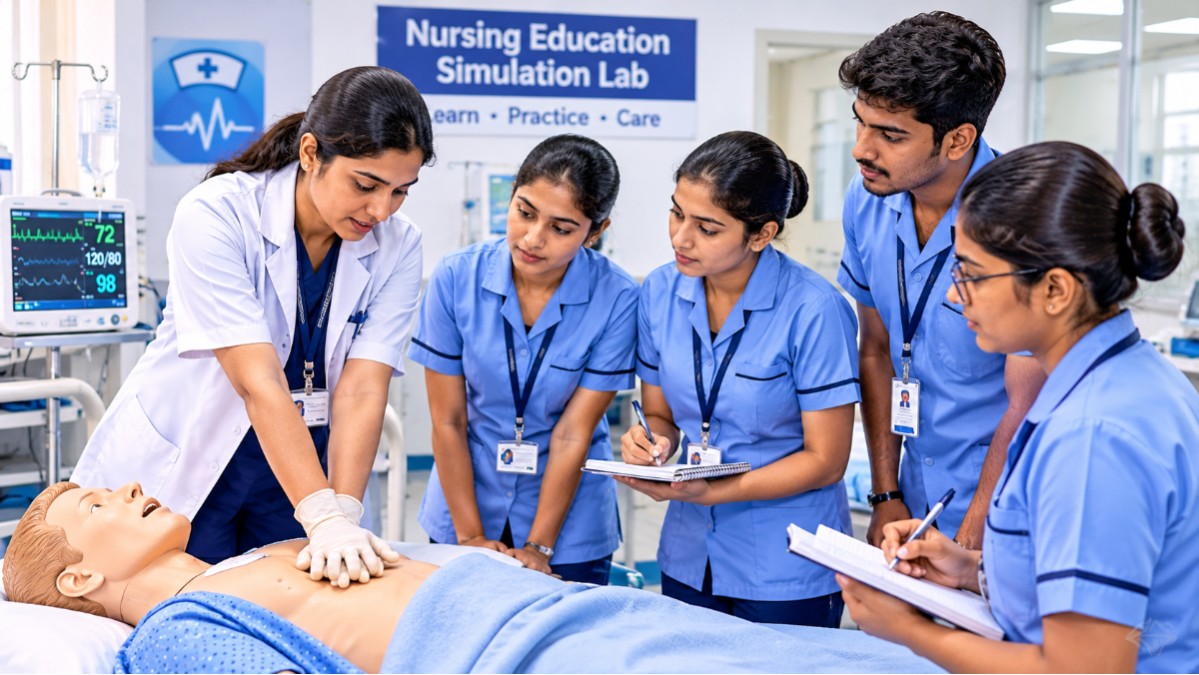
Choosing a healthcare course after Class 12 or PUC is a big decision. Students and parents often ask the same questions: Is B.Sc Nursing a good career, who is eligible, how does admission work, what will students study and how is it different from GNM or other paramedical courses?
B.Sc Nursing is a four-year undergraduate programme that prepares students to provide patient care, support doctors, promote health and work in hospitals, clinics and community settings. It combines classroom learning with supervised clinical training, so students learn both the science of healthcare and the practical skills of caring for patients.
Bangalore has a large number of hospitals, clinics and healthcare institutions, which is why many students consider the city for nursing education. However, choosing a college involves more than location. Students should verify approvals, hospital training facilities, curriculum, fees and placement information before deciding.
This guide explains what B.Sc Nursing involves, who it suits, how admissions work, how it compares with other courses and what career paths students can explore.
What Is B.Sc Nursing?
B.Sc Nursing is a professional healthcare degree that teaches students to assess patient needs, provide nursing care, administer treatments under medical direction, educate patients and families, and support public health. The programme usually runs for four years and includes theory classes, laboratory practice and clinical postings in hospitals and community settings.
In India, nursing education and registration are regulated by the Indian Nursing Council (INC) and state nursing councils. In Karnataka, many nursing colleges are affiliated with Rajiv Gandhi University of Health Sciences (RGUHS). Always confirm a college's current approvals and affiliation through official sources.
Who Should Consider B.Sc Nursing?
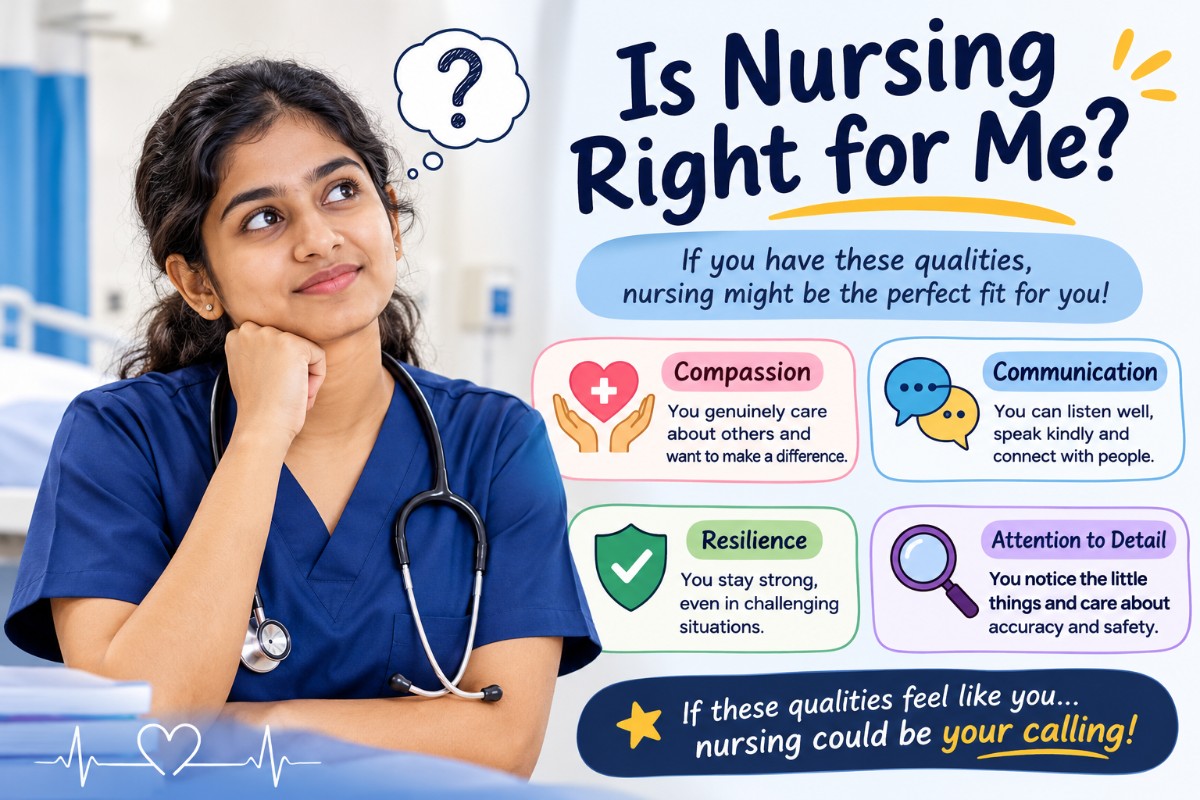
This course may suit you if you:
- Want a healthcare career focused on caring for people.
- Have studied or enjoy Biology and want to apply science in a practical setting.
- Can stay calm, patient and attentive in demanding situations.
- Communicate well with patients, families and healthcare teams.
- Are comfortable with hospital environments, shift work and long periods on your feet.
Nursing involves responsibility and emotional resilience as well as technical skill. Speaking to nursing students or working nurses can help you understand the daily reality before you commit.
Why Study B.Sc Nursing in Bangalore?
Bangalore has a wide healthcare sector, including government and private hospitals, specialty centres and community health programmes. For nursing students, this can offer useful exposure, depending on the college's tie-ups and training arrangements.
- Clinical exposure: Hospital postings help students practise skills in real patient-care settings under supervision.
- Variety of departments: Students may rotate through medical, surgical, paediatric, maternity, mental health and community settings.
- Learning environment: Skill labs, simulation practice and supervised training help build confidence.
- Career awareness: Being close to many healthcare institutions can help students understand different nursing roles.
Studying in Bangalore does not guarantee a job or salary. Outcomes depend on the quality of training, your skills and attitude, registration status and employer requirements. Judge each college on verified evidence, not advertising alone.
B.Sc Nursing Eligibility Criteria
Eligibility is set by the Indian Nursing Council, state authorities and the affiliating university, and it can be updated. In general, applicants are expected to have:
- Passed Class 12, PUC or an equivalent examination with Physics, Chemistry, Biology and English.
- The minimum aggregate marks required for the programme and admission route.
- The minimum age specified for admission, as per current rules.
- Medical fitness, where required by the college or hospital.
Different seat categories, including government, private and management quota, may follow different procedures. Check the current notification from the relevant authority for the cycle you are applying to, rather than depending on last year's information.
Students who have completed GNM may be eligible for the Post Basic B.Sc Nursing route, subject to eligibility and registration conditions.
B.Sc Nursing Syllabus: What Will You Study?
The exact subjects and semester order follow the curriculum prescribed by the Indian Nursing Council and the affiliating university, and these can change. In general, the programme moves from basic sciences to specialised nursing care:
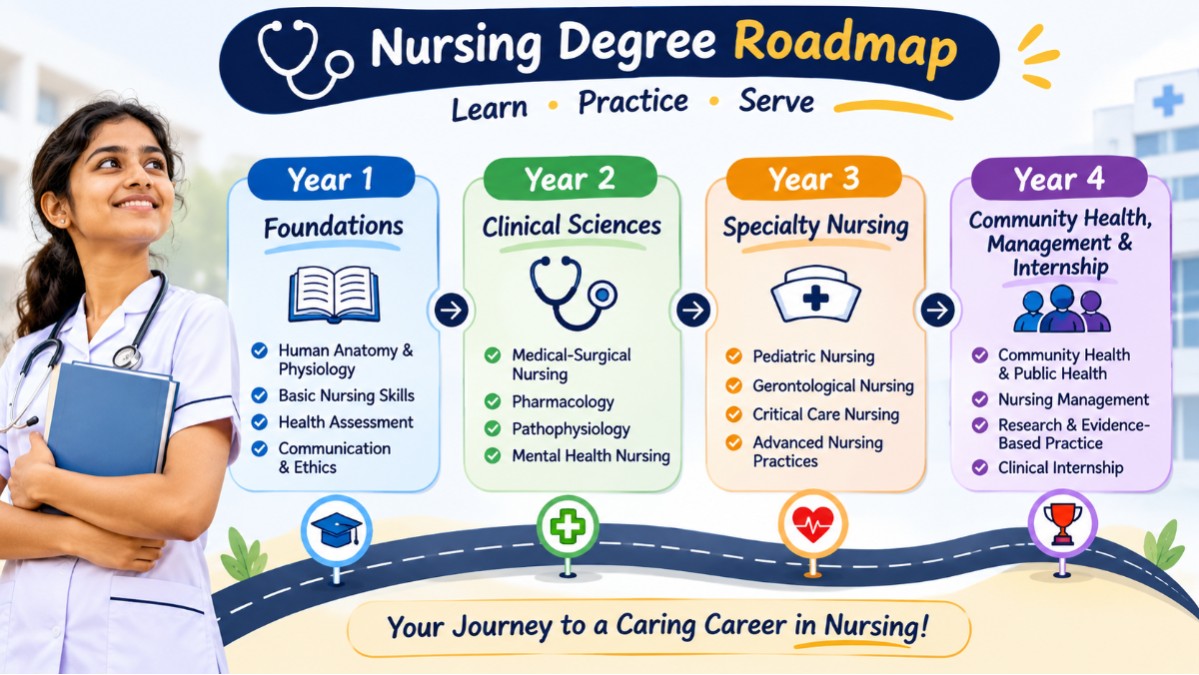
Foundation and basic sciences
- Anatomy, physiology, biochemistry, nutrition and microbiology.
- Psychology, sociology and communication skills.
- Fundamentals of nursing, including basic patient care and clinical procedures.
Clinical and specialty nursing
- Pharmacology and pathology.
- Medical-surgical nursing.
- Child health nursing.
- Mental health nursing.
- Midwifery and obstetrical nursing.
Community, research and management
- Community health nursing and public health.
- Nursing research and statistics.
- Nursing management, leadership and professional ethics.
Clinical training and internship
Clinical practice is a central part of B.Sc Nursing. Students complete supervised postings in different hospital departments and community settings, and the programme typically ends with an internship. Ask each college how clinical hours, hospital partnerships and supervision are organised.
Skills a Good Nurse Builds
- Clinical skills: Taking vital signs, giving medication safely, wound care, patient monitoring and infection control.
- Communication: Listening to patients, explaining care clearly and coordinating with doctors and colleagues.
- Critical thinking: Noticing changes in a patient's condition and responding appropriately.
- Compassion and ethics: Respecting dignity, privacy and informed choice.
- Teamwork and stress management: Working in shifts and handling pressure calmly.
- Documentation: Recording patient information accurately and on time.
How Does B.Sc Nursing Admission Work in Bangalore?
The process depends on the college, the seat type and the current rules in force. Follow official notifications for each admission cycle.
Step 1: Check eligibility
Confirm subjects, minimum marks, age and other conditions for B.Sc Nursing.
Step 2: Identify the admission route
Understand whether you are applying for a government-quota seat, a private-college seat or a management-quota seat, because each can have a different process.
Step 3: Register through the right channel
Where counselling or centralised admission applies, register through the official portal. For direct admissions, apply to the college as per its published process.
Step 4: Check college approvals
Before accepting a seat, verify the college's INC recognition, affiliation, hospital training facilities and approvals through official sources.
Step 5: Submit documents
Prepare mark sheets, identity proof, category or domicile certificates, photographs and any other documents the college lists.
Step 6: Confirm fees and complete admission
Get a written fee structure, keep all receipts and read the refund and rules policy before paying.
How to Choose the Right Nursing College in Bangalore
1. Verify recognition and approvals
Check that the college is recognised by the Indian Nursing Council and state nursing council and is affiliated with the relevant university. Use official websites, not only the college's own claims.
2. Check the hospital and clinical training setup
Ask whether the college has its own teaching hospital or formal tie-ups, which departments students rotate through and how clinical supervision works.
3. Review faculty and learning facilities
Look at faculty qualifications, student-teacher interaction, skill labs, library resources and simulation facilities.
4. Look at outcomes with evidence
Ask for recent data on student results, internships and placements, including the reporting year. Be careful about promises of guaranteed jobs or very high salaries.
5. Understand the full cost
Ask for tuition, hostel, uniform, clinical-posting, examination and other charges in writing. Fees differ by college and seat type, so this article does not quote a standard figure.
6. Consider the student experience
Consider hostel facilities, safety, travel distance to clinical sites and student support. If possible, speak with current students or alumni.
B.Sc Nursing vs Other Courses: Course Comparison
Students often compare B.Sc Nursing with GNM, ANM and allied health courses. Durations and eligibility follow current regulations, so confirm them with the official authority.
B.Sc Nursing vs GNM: Which should you choose?
B.Sc Nursing is a degree programme that generally includes a broader academic base, including research and management, and can open doors to postgraduate study and education roles. GNM is a diploma route with a strong clinical focus and a shorter duration. Eligibility, cost, career goals and how you prefer to learn should guide your decision. Both lead to nursing registration when the legal requirements are met.
B.Sc Nursing vs Allied Health Courses
Nursing is centred on direct patient care, while allied health courses often focus on diagnostic, laboratory or technical support. Think about whether you want hands-on patient contact or a technical role behind the scenes.
What to compare before deciding
- Course duration, eligibility and total cost.
- Recognition and registration requirements.
- Clinical training and internship structure.
- Higher-study options and career growth.
- Your own interest in direct patient care.
Career Opportunities After B.Sc Nursing
After completing the degree and meeting registration requirements, graduates can explore a range of roles. Opportunities depend on skills, experience, registration and employer needs.
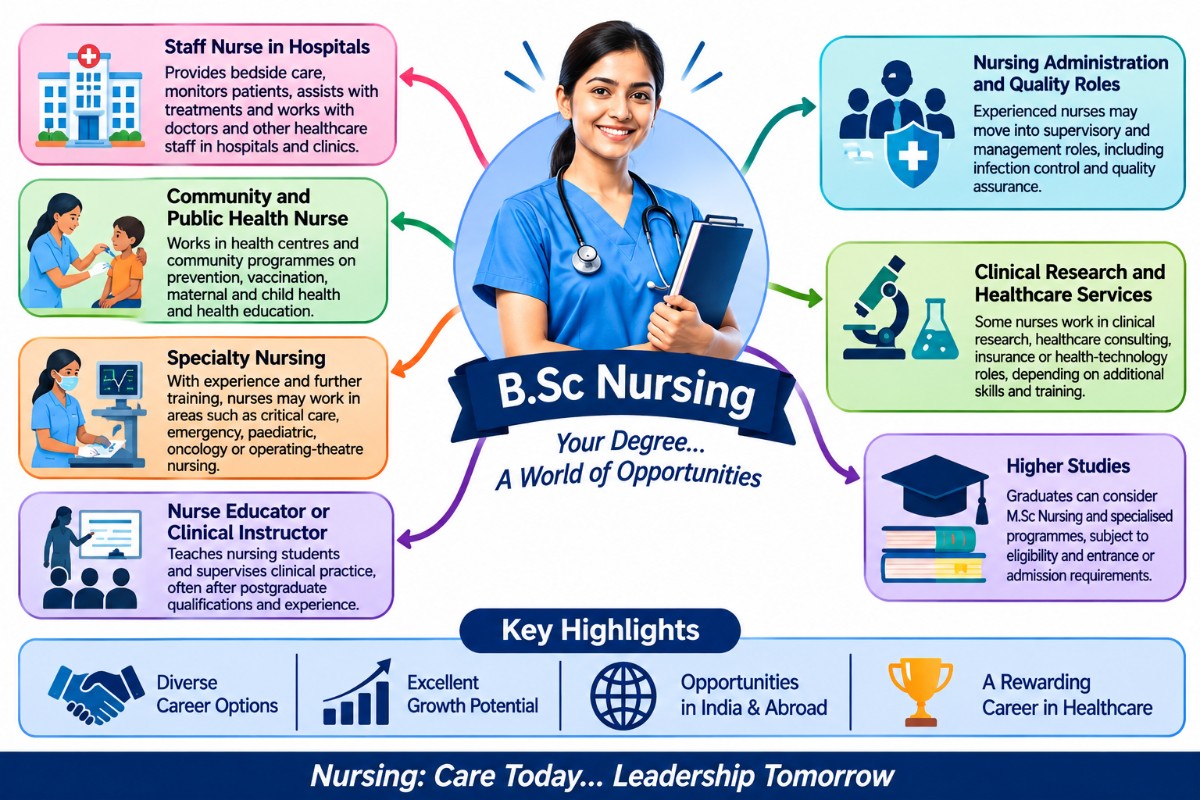
Staff nurse in hospitals
Provides bedside care, monitors patients, assists with treatments and works with doctors and other healthcare staff in hospitals and clinics.
Community and public health nurse
Works in health centres and community programmes on prevention, vaccination, maternal and child health and health education.
Specialty nursing
With experience and further training, nurses may work in areas such as critical care, emergency, paediatric, oncology or operating-theatre nursing.
Nurse educator or clinical instructor
Teaches nursing students and supervises clinical practice, often after postgraduate qualifications and experience.
Nursing administration and quality roles
Experienced nurses may move into supervisory and management roles, including infection control and quality assurance.
Clinical research and healthcare services
Some nurses work in clinical research, healthcare consulting, insurance or health-technology roles, depending on additional skills and training.
Higher studies
Graduates can consider M.Sc Nursing and specialised programmes, subject to eligibility and entrance or admission requirements.
Abroad job opportunities for B.Sc Nursing graduates
Many Indian nurses explore careers overseas because healthcare systems in several countries recruit internationally trained nurses. Demand, requirements and visa rules change often and differ by country, state or province, so treat the points below as a starting guide and confirm everything with the official nursing regulator and government immigration website of your chosen country.

Countries Indian nurses commonly explore:
- United Kingdom: Nurses generally need registration with the Nursing and Midwifery Council (NMC), proof of English ability and the required competence assessments before working as a registered nurse.
- United States: Internationally educated nurses usually need a credential evaluation, a licence from the state board of nursing, passing the NCLEX-RN and the appropriate visa. Requirements vary by state.
- Canada: Nurses usually go through a credential assessment and registration with the provincial or territorial nursing regulator, and may need to pass the NCLEX-RN and show language proficiency. Each province has its own process.
- Australia and New Zealand: Registration with the national nursing regulator, English-language evidence and, in many cases, a competence assessment are required before practising.
- Ireland: Registration with the Nursing and Midwifery Board of Ireland (NMBI) is required, along with proof of qualification and English ability.
- Germany and other European countries: Recognition of your nursing qualification and language skills, often German to a required level for Germany, are typically needed before registration.
- Gulf countries (UAE, Saudi Arabia, Qatar, Kuwait, Oman): Nurses usually need to clear the licensing or eligibility process of the respective health authority, and recruitment for some Gulf countries is regulated in India. Check the Ministry of External Affairs and eMigrate guidelines and use only registered recruiters.
What you typically need to work as a nurse abroad:
- A recognised nursing degree and registration: Valid registration with your Indian state nursing council is often the starting point, and your degree usually needs to be verified.
- English-language test scores: Tests such as IELTS or OET are commonly accepted for nursing, but accepted tests and minimum scores differ by regulator.
- Licensing or competence exams: Examples include NCLEX-RN for the USA and parts of Canada, and competence assessments for the UK and Australia.
- Clinical experience: Some employers and countries prefer or require work experience after graduation, so gaining hospital experience in India first can help.
- Visa and work authorisation: A job offer or sponsorship is commonly needed, and visa conditions change frequently.
- Documents and verification: Transcripts, internship records, experience letters and police clearance are common requirements.
Practical steps to prepare for overseas nursing jobs:
- Step 1: Complete your B.Sc Nursing and obtain your state nursing council registration.
- Step 2: Choose a target country and read its nursing regulator's page for international applicants.
- Step 3: Prepare for and take the required language and licensing exams.
- Step 4: Build clinical experience and strengthen your CV.
- Step 5: Apply through official hospital career pages, government recruitment programmes or registered recruiters.
- Step 6: Complete credential evaluation, licensing and visa steps as per official instructions.
Be cautious of anyone who asks for large upfront payments or promises guaranteed overseas placement. Use official regulator websites and registered recruiters, and keep written records of every payment and agreement.
A degree does not guarantee a particular job or salary. Registration, practical skills, professionalism and continuous learning all matter.
How Students Can Prepare Before Joining
- Strengthen Biology basics: Revise human body systems and basic health concepts.
- Build communication skills: Practise speaking clearly and listening carefully.
- Learn about the profession: Read about nursing roles and talk to nurses.
- Look after your own health: Nursing is physically and emotionally demanding.
- Keep documents ready: Organise mark sheets, identity and category certificates early.
Is B.Sc Nursing a Good Career Choice?
B.Sc Nursing can be a meaningful career for students who care about helping people and are ready for the responsibility, discipline and long hours that healthcare involves. Nurses are needed across hospitals, clinics, community programmes and other settings, and the degree offers paths into specialisation, education and management.
At the same time, it is demanding work, and results depend on the quality of your training and your own commitment. Compare B.Sc Nursing with GNM and other healthcare courses, check college approvals carefully and, if you need help, speak with a counsellor who can explain your options and the admission process.